Ways to Pay for Assisted Living in Florida: A Guide for Palm Bay Families
A practical Palm Bay guide to costs, private resources, Florida Medicaid, VA benefits, insurance and free planning help.
Learning how to pay for assisted living in Florida usually means combining resources rather than finding one program that covers everything. For Palm Bay families, a workable plan starts with the person's daily support needs, a written community quote, and a realistic view of income, savings, insurance and public benefits. Local cost medians help with budgeting, but they are not a price quote for any particular home.
It also helps to separate housing and meals from hands-on care. That distinction matters when comparing private pay, Florida Medicaid, VA pensions and long-term care insurance. Each resource has limits, and the right order of steps depends on health needs, timing and whether a spouse remains at home.
Match the payment plan to the care setting
Assisted living can combine housing, meals and personal support, while memory care provides a supervised setting and dementia-specific staff training for people who need that environment. It should be understood as support and supervision, not as treatment that promises a change in the condition. Respite care is temporary. Families comparing assisted living in Palm Bay should ask which services are included and which needs would change the monthly charge.
Home At Last Of Brevard offers assisted living, memory care and respite care in a small cottage-style home at 380 Englar Ave NE in Palm Bay. Call (321) 327-3573 for current rates and availability. Before comparing it with another option, request a written service list, ask how care needs are reviewed, and clarify any charges beyond the basic rate. A lower quoted rate is not directly comparable if it covers less support.
Palm Bay care costs: use medians as a baseline
These medians describe a market, not an individual community's charges.
More hours at home do not automatically include home maintenance, food or other expenses that may be bundled elsewhere. The 20-hour and 168-hour figures are arithmetic planning estimates, not predictions of what a particular household will need or pay.
Nursing home figures represent a different care setting and should not be treated as assisted living quotes. Compare supervision, meals, activities, transportation, personal supplies and care-related additions, then build a budget around the services actually needed.
How to pay for assisted living in Florida with private funds
Private pay often combines Social Security, pensions, other retirement income and savings. List dependable monthly income first, then decide how much savings can be used without ignoring a spouse's needs, home repairs or future care. Compare that plan with a written quote showing the basic charge and possible care-related additions. A reserve for fee changes and unexpected expenses is more useful than a budget that spends every available dollar.
Home equity may become part of the plan through a sale or downsizing, but equity is not the same as cash available this month. Allow time for repairs, listing, closing and moving. If a spouse will remain in the home, or if Medicaid or VA planning is possible, get Florida legal and tax guidance before selling, transferring ownership or signing a loan. Avoid a plan that depends on a fast sale or a particular sale price.
- Which services and care supplies are included in the basic rate?
- How are changes in care needs assessed and billed?
- Which deposits, community fees or other one-time charges apply?
- What are the terms for increases, absences, discharge and refunds?
Florida Medicaid: services, room and board, and the waitlist
For families asking how to pay for assisted living in Florida with limited resources, the relevant statewide option is Florida's Statewide Medicaid Managed Care Long-Term Care program. According to the Agency for Health Care Administration, it can cover assisted living services, personal care, adult day care and respite for Medicaid-eligible people aged 65 or older, or 18 or older with a disability, who need a nursing facility level of care. Financial eligibility and the functional assessment are separate parts of the process.
Coverage of assisted living services is not payment of the entire private bill. Medicaid does not pay the room-and-board portion through this services benefit, so ask what housing and food cost remains and who must pay it. Also confirm whether a particular Palm Bay home participates before relying on the program. Eligibility alone does not establish that a community will accept the benefit.
Enrollment is limited and there is a waitlist. Screening starts through the local Aging and Disability Resource Center; the Elder Helpline is 1-800-963-5337. Ask about the screening, current wait, required documents and what happens after enrollment. Starting early can preserve options, but it does not guarantee immediate placement or funding.
VA Aid and Attendance: use the rate as a ceiling, not a promise
VA Aid and Attendance is an increased monthly amount added to a VA pension for eligible wartime-era Veterans or surviving spouses who need help with daily activities, among other qualifying circumstances. It is not an automatic payment to an assisted living community, and the pension calculation still applies.
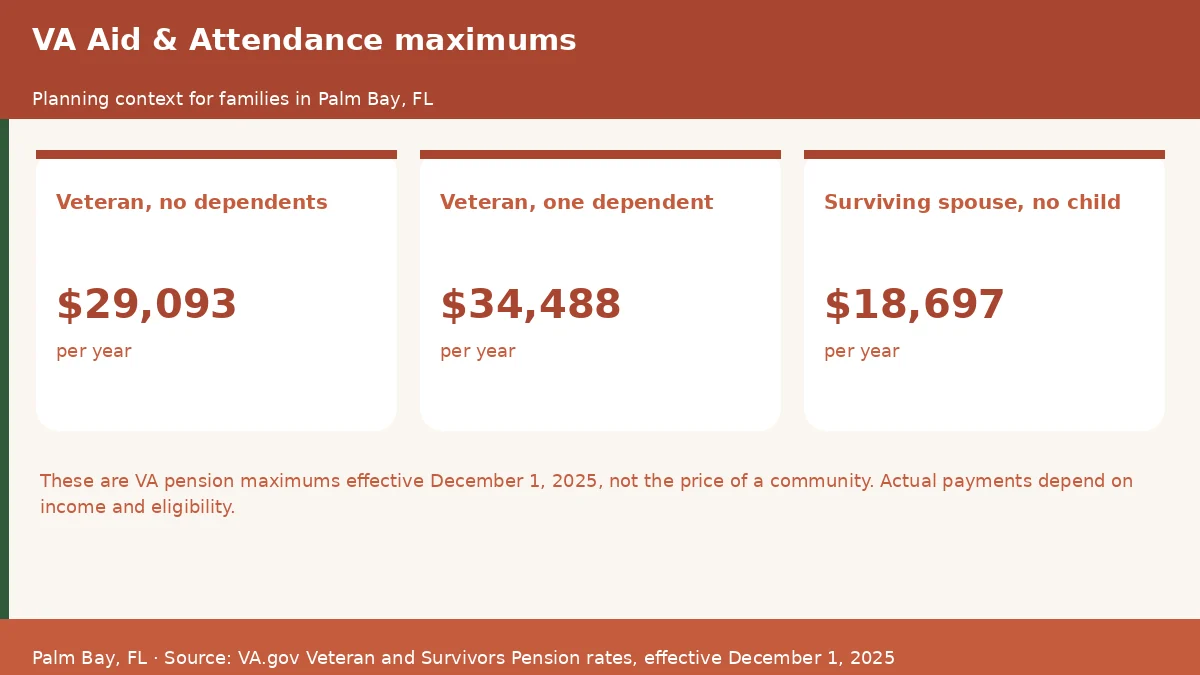
For rates effective December 1, 2025, the VA pension rate tables list a Maximum Annual Pension Rate with Aid and Attendance of $29,093 for a Veteran with no dependents. These are maximum-rate examples, not promised deposits or rates for every surviving spouse.
The VA net worth limit from December 1, 2025 through November 30, 2026 is $163,699. Pension is generally the applicable maximum rate minus countable income. Unreimbursed medical expenses, which can include care costs, above 5% of that rate may reduce countable income. The VA also reviews asset transfers during the 3 years before a claim, with a penalty period of up to 5 years. Obtain qualified guidance before transferring assets or filing.
Long-term care insurance and Medicare have different roles
Long-term care insurance may pay for assisted living, but only under the actual policy. Benefits usually start after an elimination period and when the insured needs help with activities of daily living or has cognitive impairment. Ask the insurer whether a small residential assisted living or memory care setting qualifies, how the benefit is calculated, what documentation is required, and whether a lifetime or other maximum applies. Keep paying premiums when required and get claim decisions in writing.
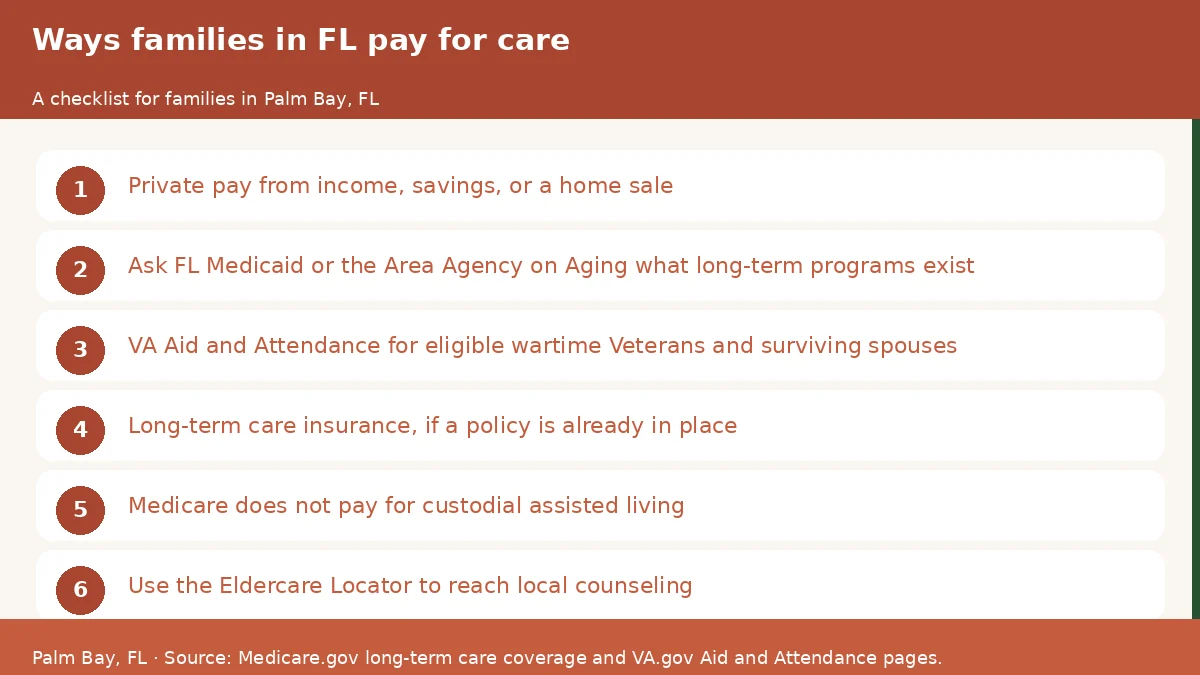
Medicare serves a different role. Medicare's long-term care guidance states that it does not cover long-term custodial care if that is the only care needed, and most long-term care is custodial. Other covered health services follow their own rules, but they do not turn Medicare into an ongoing source for assisted living room, board and daily supervision. Review insurance before assuming any gap is covered.
Use respite care while the longer-term plan takes shape
Respite can support a caregiving plan while longer-term funding is sorted out. The National Institute on Aging describes it as a short-term break that can occur at home, in an adult day center or through a short residential stay. A planned respite care stay in Palm Bay should come with written terms covering dates, included support and billing, without assuming that a later opening or rate will be available.
Use the stay to organize medication lists, routines, mobility needs and the information caregivers rely on. For dementia caregivers, the the National Institute on Aging also explains respite options and operates a 24/7 Helpline at 1-800-272-3900. These are practical supports, not promises about the course of memory loss.
Free guidance and a careful local review
Free, neutral guidance can prevent expensive misunderstandings. The Eldercare Locator, a service of the U.S. Administration for Community Living, connects families with local Area Agencies on Aging at 1-800-677-1116. Palm Bay families can use it to find the aging office and Aging and Disability Resource Center serving their address, then ask about benefits counseling, caregiver support and Medicaid screening.
For any community under consideration, verify its status with Florida's Agency for Health Care Administration. AHCA licenses assisted living facilities, and Florida requires Alzheimer's and dementia training for staff in facilities that advertise memory care. A cottage appearance alone does not establish a license category or service capability. Ask about the license, staff training, supervision, emergency procedures and how the home responds when needs increase.
Keep one folder with the written quote, care assessment, insurance policy, benefit correspondence and questions still unanswered. A durable plan shows who pays each part, when benefits might begin, what happens during a wait, and when the plan must be reviewed.
Frequently asked questions
Does Florida Medicaid pay for assisted living in Palm Bay?
Florida's Statewide Medicaid Managed Care Long-Term Care program can cover assisted living services for Medicaid-eligible people who are 65 or older, or 18 or older with a disability, and who need a nursing facility level of care. It does not simply cover the entire private bill; room and board are separate. Enrollment is limited and there is a waitlist. Palm Bay families begin screening through the local Aging and Disability Resource Center and should confirm whether a specific home participates.
Does Medicare pay for assisted living in Florida?
Medicare does not cover long-term custodial care when that is the only care a person needs, and most long-term care is custodial. That means Palm Bay families should not budget for Medicare to pay an ongoing assisted living bill for housing, meals, supervision and help with daily activities. Other covered health services follow Medicare's own rules, but they are separate from long-term residential payment. Review the person's specific coverage before making assumptions.
Can VA Aid and Attendance help a Palm Bay veteran?
It may help a wartime-era Veteran or surviving spouse who qualifies for the VA pension and meets the additional Aid and Attendance criteria. The amount is added to a pension; it is not an automatic assisted living reimbursement. Payment depends on the applicable rate and countable income, and care costs may affect that calculation. Asset-transfer rules and a net worth limit also matter. Palm Bay families should verify current rates and seek qualified application help before moving money.
Is memory care paid for differently from assisted living in Palm Bay?
The payment source and the care setting are separate questions. Savings, income, long-term care insurance and certain public benefits may apply differently depending on the policy or program, but memory care itself is support, supervision and a structured environment rather than a promised medical outcome. Ask each Palm Bay community for a written description of included services and charges. Then ask the insurer or program whether that specific setting and those services qualify.
Can respite care help a family plan for assisted living?
Yes. Respite care gives a family caregiver a short-term break and may be provided at home, through an adult day center or during a short residential stay. For a Palm Bay family, it can also clarify what daily supervision and personal help are needed before a longer decision. Ask about the length of the stay, included support, billing terms and required care information. A respite stay does not guarantee later availability or a particular rate.
Talk with Home At Last Of Brevard
If you are weighing care options in Palm Bay, call (321) 327-3573 or visit. Our team can talk through current availability, rates and next steps. Please confirm all details directly, since published figures and listings change over time.
Sources
- VA Aid and Attendance and Housebound benefits
- VA pension rates (current)
- Medicare: long-term care coverage
- Eldercare Locator (U.S. Administration for Community Living)
- National Institute on Aging: What is respite care?
- the National Institute on Aging: respite care
- ACL: What is long-term care insurance
- Florida AHCA: Assisted Living Unit
- Florida AHCA: Statewide Medicaid Managed Care Long-Term Care Program
Program rules and benefit amounts were checked on the linked official pages in November 2026 and can change.
Related reading on this site: