Signs It's Time for Assisted Living: A Guide for Palm Bay Families
A practical guide to daily-life warning signs, dignified family conversations, respite stays and local care planning in Palm Bay.
The idea often surfaces quietly: a parent stops cooking, a spouse is exhausted after another broken night, or a familiar Palm Bay house suddenly seems full of risks. For families noticing signs it's time for assisted living in Palm Bay, the hardest part is often separating a single rough week from a lasting change. A careful look at daily routines can make the decision clearer and less driven by fear.
Assisted living is not a verdict on a person's independence. It is one way to add help with everyday life while preserving choices, privacy and dignity. The goal is to notice patterns early enough to compare options calmly rather than waiting for a crisis to dictate the next step.
Signs it's time for assisted living in Palm Bay
Start with what has changed over several weeks or months. A messy refrigerator after an illness may mean little; repeated difficulty with basic routines deserves attention. Record specific observations rather than using labels such as incapable or confused.
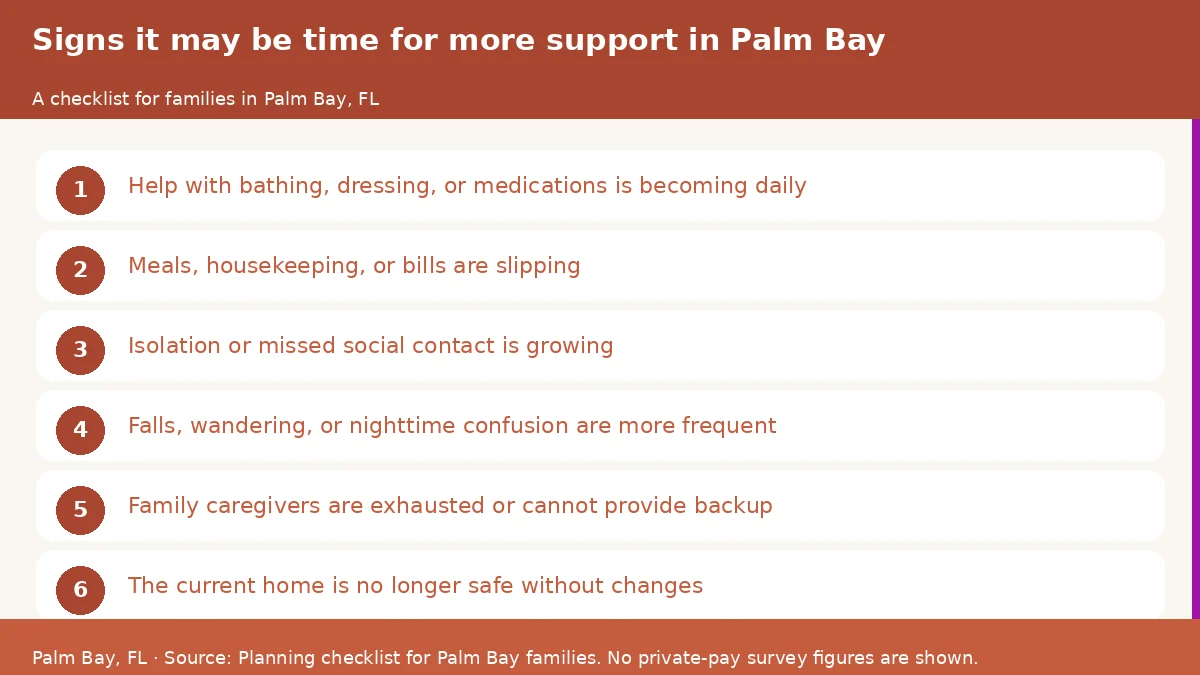
- Personal care keeps sliding. Bathing, dressing, grooming or getting to the bathroom may take much longer, be avoided or require more hands-on help than family can reliably provide.
- Medication routines are unreliable. Pills remain in an organizer when they should have been taken, refills are missed, or there is repeated uncertainty about whether a dose was taken.
- Meals and housework are slipping. Look for spoiled food, little food suitable for regular meals, mounting laundry, unpaid bills or household tasks that go unfinished despite repeated reminders.
- Movement around home is becoming harder. A fall, near-fall, new reluctance to use stairs, difficulty rising from a chair or fear of walking to the bathroom at night can change how much supervision is needed.
- Everyday judgment needs backup. Appliances left on, doors left open, unusual purchases or trouble managing familiar appointments may show that occasional reminders are no longer enough.
A simple log can clarify the pattern. Note what happened, what help was needed and whether the same difficulty returned. Also record what is going well. Abilities that remain intact should shape the plan just as much as the problems.
Safety, isolation and caregiver strain belong in the same picture
Often, the signs it's time for assisted living in Palm Bay include the caregiver's condition, not just the older adult's. A spouse who is no longer sleeping, an adult child repeatedly leaving work, or family members driving from Melbourne or West Melbourne for daily emergencies may be holding together an arrangement that is no longer sustainable.
Safety is broader than fall prevention. Consider whether your parent can summon help, manage the stove, move around at night and respond appropriately to an unexpected problem. Ask what happens when the usual caregiver is ill, delayed or simply too tired. A backup plan that depends on one exhausted person is fragile.
Social withdrawal matters too. A parent may stop calling friends, eating at regular times or taking part in activities once enjoyed. Days with little conversation can make a familiar home feel very small. Assisted living can offer shared meals and opportunities for company, but the right question is whether your parent would welcome and use those opportunities.
Caregiver resentment, dread or constant worry are not evidence of a lack of love. They are signals to reassess the workload. Bringing in help or considering a move can protect the relationship by allowing family visits to include more than tasks and troubleshooting.
Start the conversation without taking away your parent's voice
Choose a calm time, not the immediate aftermath of a fall or argument. Lead with concern and specific observations: the untouched medication organizer, the laundry that has become difficult or the nights a spouse spends awake. Avoid announcing a decision as though it has already been made.
- Ask about priorities. Privacy, familiar routines, help with dressing, regular meals or relief from home maintenance may matter differently to your parent than they do to you.
- Describe support before discussing a move. Explore what would make daily life easier, then compare whether that help can be delivered reliably at home.
- Offer meaningful choices. Include your parent in visits, questions and decisions about timing whenever possible. Do not promise that a move will never happen.
- Allow more than one conversation. A parent may need time to consider the idea. A clinician can also help evaluate new functional changes or medication concerns.
Adult children may disagree about urgency. A family meeting works better when everyone reviews the same observations instead of trading general opinions. If one person provides most of the care, that person's account of the daily workload deserves particular weight.
Use a visit or respite stay to test the fit
A tour shows the rooms and common spaces, but it cannot fully show how daily support feels. According to the National Institute on Aging, respite care gives family caregivers a short-term break and can take place at home, in an adult day center or during a short residential stay.
A planned respite care stay can help a family observe preferences around meals, privacy, personal care, evening routines and social contact without framing the experience as a permanent commitment. It can also give a spouse or adult child enough uninterrupted rest to think more clearly about the next decision.
The the National Institute on Aging also identifies respite as a care option for dementia caregivers. Treat a stay as information gathering, not a test your parent can fail. Ask beforehand what belongings to bring, how routines will be discussed and how family will receive updates.
What Palm Bay-area care costs mean for planning
The , based on data collected from July through November 2025, provides planning benchmarks for the Palm Bay Area, the region used for the Palm Bay-Melbourne-Titusville metro. These figures are medians or stated scheduling examples, not quotes for any residence.
The 20-hour and 168-hour home care examples are arithmetic illustrations using the local hourly rate. That is not a like-for-like comparison: caregiver hours at home may leave housing, food, utilities and upkeep as separate expenses, while assisted living fee structures vary.
These comparisons describe broad markets, not the value or fit of a particular home.
When comparing assisted living in Palm Bay, use the figures to test a family budget and identify questions. Ask what personal care, meals, medication support and other services are included, and what could cost extra. Cost alone cannot determine whether a setting provides the right supervision.
Understand what Medicare, insurance, VA benefits and Medicaid can do
Medicare's long-term care guidance says Medicare does not cover long-term custodial care when that is the only care needed, and most long-term care is custodial. Families should not assume Medicare will pay an ongoing assisted living bill.
Long-term care insurance may help, depending on the policy. The Administration for Community Living explains that benefits commonly begin after an elimination period and when specified needs involving daily activities or cognitive impairment are met. Read the actual policy and ask the insurer to confirm its requirements.
VA Aid and Attendance can increase a VA pension for eligible wartime-era Veterans or surviving spouses who meet criteria such as needing help with daily activities. It is not an automatic payment simply because someone moves to assisted living.
The current VA pension rates list an annual Maximum Annual Pension Rate with Aid and Attendance of $29,093 for a Veteran with no dependents and $34,488 for a Veteran with one dependent. The net worth limit is $163,699 for December 1, 2025 through November 30, 2026. Pension calculations account for countable income, and certain unreimbursed medical expenses can affect that calculation. VA also reviews some asset transfers, so obtain qualified guidance before transferring property or money.
Florida's Statewide Medicaid Managed Care Long-Term Care program can cover services including assisted living services, personal care, adult day care and respite for eligible people who need a nursing-facility level of care. Enrollment is limited and there is a waitlist. Screening begins through the local Aging and Disability Resource Center, so early inquiry is preferable to assuming funds will be available immediately.
Turn local visits into a practical comparison
Florida's Agency for Health Care Administration licenses assisted living facilities and describes specialty licenses for Extended Congregate Care, Limited Nursing Services and Limited Mental Health. Florida also requires Alzheimer's and dementia training for staff in facilities that advertise memory care. During a visit, ask about the license, staff training, overnight supervision, personal care, medication routines and how changing needs are reviewed.
Home At Last Of Brevard is a small cottage-style home at 380 Englar Ave NE in northeast Palm Bay. It offers assisted living, memory care and respite care. Memory care should be discussed in terms of support, supervision and environment, without promises of improvement. Ask how each service would apply to your parent's current routines and what circumstances might require a different setting.
Metro medians do not establish this home's prices. Call Home At Last Of Brevard for current rates and request a clear explanation of included services and possible additional charges. A sound decision combines affordability with dignity, reliable help and a realistic plan for the caregiver as well as the person receiving care.
Frequently asked questions
What are the clearest signs it is time for assisted living in Palm Bay?
Look for repeated changes rather than one isolated mistake. Concerns include bathing or dressing becoming difficult, unreliable medication routines, spoiled food or unpaid bills, increasing falls or near-falls, and an older adult being left without enough help. In Palm Bay, also consider whether family living in Melbourne or West Melbourne can realistically sustain daily check-ins. A pattern across several areas deserves a calm assessment and a broader conversation.
How can a respite stay help a Palm Bay family decide?
A short residential respite stay can give a Palm Bay parent and caregiver a low-pressure way to learn what daily support feels like. It can reveal preferences about meals, privacy, personal care, routines and social contact while giving the caregiver time to rest. Respite can also be provided at home or through an adult day program. Treat the stay as information gathering, not a test or a promise of permanent placement.
What is the median assisted living cost in the Palm Bay Area?
These are market benchmarks, not quotes for any particular residence, and they do not establish what services are included. Home At Last Of Brevard's current rates must be obtained directly from the home.
Does Medicare cover assisted living in Brevard County?
Medicare does not cover long-term custodial care when that is the only care needed, and most long-term care is custodial. Palm Bay families should not assume it will pay an ongoing assisted living bill. Review any long-term care insurance policy directly, including its elimination period and benefit triggers. Eligible Veterans or surviving spouses can also explore VA pension options, while Florida Medicaid has a separate long-term care program with eligibility rules and limited enrollment.
How is memory care different from assisted living in Palm Bay?
Assisted living generally helps with daily routines, while memory care adds dementia-focused support, supervision and an environment planned around cognitive changes. Neither should be presented as a cure or a promise of improvement. In Palm Bay, ask what staff dementia training is required and provided, how supervision works, how personal care is delivered, and what happens if needs change. Florida requires dementia training for staff in facilities that advertise memory care.
Talk with Home At Last Of Brevard
If you are weighing care options in Palm Bay, call (321) 327-3573 or visit. Our team can talk through current availability, rates and next steps. Please confirm all details directly, since published figures and listings change over time.
Sources
- VA Aid and Attendance and Housebound benefits
- VA pension rates (current)
- Medicare: long-term care coverage
- National Institute on Aging: What is respite care?
- the National Institute on Aging: respite care
- ACL: What is long-term care insurance
- Florida AHCA: Assisted Living Unit
- Florida AHCA: Statewide Medicaid Managed Care Long-Term Care Program
Program rules and benefit amounts were checked on the linked official pages in November 2026 and can change.
Related reading on this site: