Florida Assisted Living Licensing and Regulations Explained
A plain-English guide to Florida licenses, memory care rules, oversight and practical questions for families comparing small residential care in Palm Bay.
For an adult child comparing a small residence with a larger community, the vocabulary can be confusing: assisted living, memory care, respite care, specialty licenses and adult family-care homes do not all answer the same question. Understanding Florida assisted living regulations gives a Palm Bay family a steadier starting point. It separates legal licensing from marketing language and leaves room to judge daily support, communication and cost. Home At Last Of Brevard is a small cottage-style home at 380 Englar Ave NE in Palm Bay, offering assisted living, memory care and respite care. Those service categories are the beginning of a review, not the whole review.
Florida assisted living regulations begin with licensing
Florida's Agency for Health Care Administration (AHCA) licenses assisted living facilities under Part I of Chapter 429, Florida Statutes. The corresponding rules are in Chapter 59A-36, Florida Administrative Code. The Florida AHCA Assisted Living Unit is the official starting point for that framework.
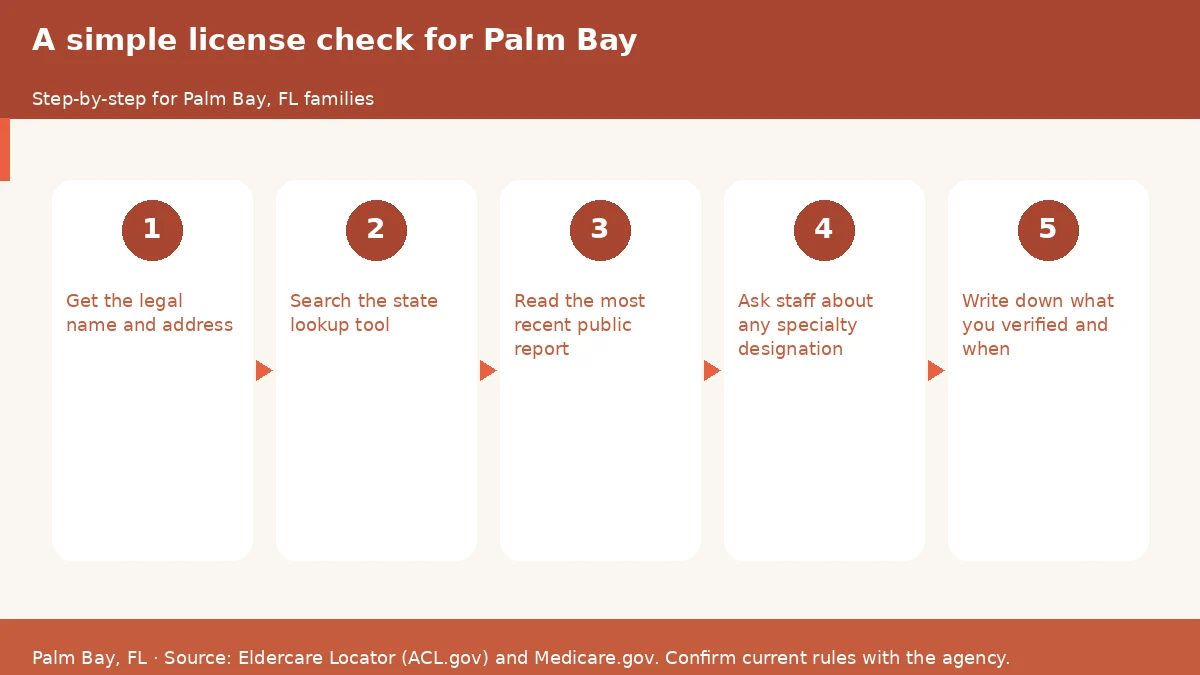
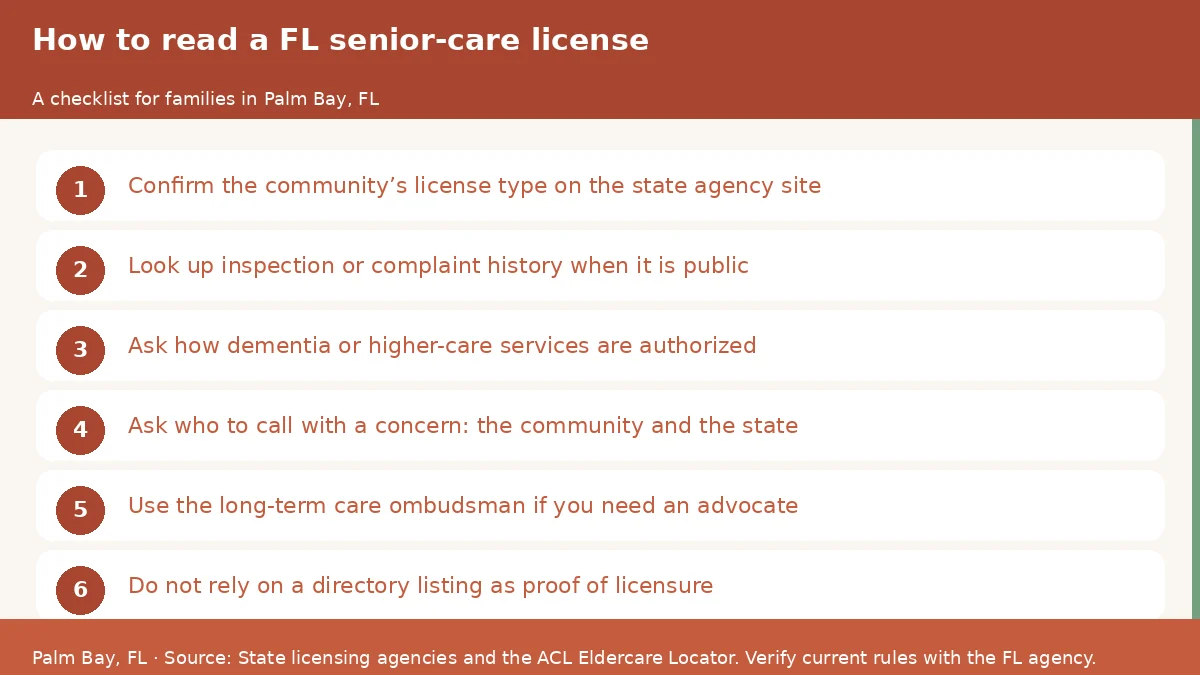
For a family, the practical step is to match the residence's legal name and address with its license information. Ask which license category applies and whether any specialty license is held. A license establishes a regulatory category; it does not measure personal compatibility, guarantee a particular experience or replace direct observation. It also should not be turned into an unofficial rating or ranking.
Keep the statutory references in mind when a conversation becomes vague. Terms such as cottage or residential may describe appearance, but they do not replace Part I of Chapter 429, Chapter 59A-36 or the separate license category described below.
License types: standard, specialty and adult family-care homes
AHCA identifies three specialty license names: Extended Congregate Care (ECC), Limited Nursing Services (LNS) and Limited Mental Health (LMH). Use the full names in notes so abbreviations do not blur together. If a residence says it holds one, ask what that license means for the services being proposed for your family member. Do not assume that every assisted living facility holds every specialty license or that the label alone confirms availability of a service.
Adult Family-Care Homes (AFCH) are a separate, smaller license type under Part II of Chapter 429. AHCA describes an AFCH as a private home where the licensee lives and cares for up to five residents. That is different from the assisted living facility framework under Part I.
This distinction matters in Palm Bay because a small house or cottage-style appearance cannot tell you which license applies. Home At Last Of Brevard's small residential description should prompt a precise license question, not an assumption. The home's size also should not be used to infer staffing, services or quality.
Memory care advertising and dementia training
Florida requires Alzheimer's/dementia training for staff in facilities that advertise memory care, under section 429.178, Florida Statutes. That gives families a specific regulatory point to verify. Ask how the requirement applies to the people who would provide day-to-day support, and ask the residence to explain its current training process without assuming a particular course length or schedule.
The next questions concern ordinary life. How is supervision organized? How are personal routines learned and revisited? What features of the environment support a person who becomes confused? How are changes communicated to a spouse or adult child? These are questions about support, supervision and environment, not about promised improvements.
Home At Last Of Brevard offers memory care as one of its service categories. A family considering it should apply the same training and daily-practice questions used anywhere else in Brevard County. Memory care should never be presented as a cure or as a guarantee that every difficult situation can be prevented.
Inspections and complaints require precise questions
Licensing, inspection information and complaints are related, but they are not interchangeable. A license is not an inspection report. An inspection or survey document, if available, should be read for its date and specific content rather than treated as a prediction about every future day.
The licensing provisions above do not give families a universal inspection timetable to recite. Instead of guessing, ask AHCA what inspection or survey information is publicly available for the exact license and when any listed review occurred. If the residence discusses a report, request enough detail to understand what document is being described. Avoid converting one document into a claim that a home is flawless or deficient in every respect.
For a concern, use AHCA's official contact or complaint channel and keep a factual record: the residence's name and address, relevant dates, what was observed and who was contacted. The Eldercare Locator, a service of the U.S. Administration for Community Living, can connect families with local Area Agencies on Aging for guidance. It is a routing resource, not a replacement for the regulator. An urgent safety risk calls for immediate local emergency help, not just a later administrative note.
A Palm Bay checklist for a cottage-style residence
A useful review brings paperwork and observation together. Home At Last Of Brevard is located at 380 Englar Ave NE in northeast Palm Bay, in southern Brevard County. Families coming from West Melbourne, Melbourne or elsewhere on the Space Coast can use the same orderly process, whether the drive involves Malabar Road or Interstate 95.
- Confirm identity and license. Match the name, address and license category, and ask about any ECC, LNS or LMH specialty license.
- Match the service to the person. Discuss assisted living, memory care or respite care in terms of the help actually needed now.
- Review dementia training when relevant. Ask how section 429.178 applies to the staff providing support.
- Separate records from impressions. Ask what public regulatory information is available, then form your own observations during a visit.
- Request written practical details. Ask what the proposed service includes, how changes in needs are discussed and how current rates and any additional charges are explained.
- Notice communication. Consider whether answers are specific, whether uncertainty is acknowledged and whether your family member is included respectfully.
The value of Florida assisted living regulations is that they give these conversations a stable reference point. They do not make the personal decision for you.
Respite care can support a careful review
Respite care can be relevant even before a family considers a longer move. The National Institute on Aging describes respite care as a short-term break for family caregivers; it can occur in the home, at adult day centers or through short stays in residential facilities.
Home At Last Of Brevard offers respite care. Before a short stay, ask what information should be shared about routines and daily assistance, what the stay includes and how a change in needs would be discussed. The same license and memory-care training questions still matter. Respite is a care arrangement for a defined period, not a shortcut around regulatory review and not a promise of a particular outcome.
Palm Bay costs belong in context
Cost should be compared with equal care. The , with data collected from July through November 2025, uses the Palm Bay Area for the local region. Its assisted living figures are:
Those comparisons describe survey medians, not the value or license status of any individual home.
A median is not a quote, and two residences may describe included services differently. Home At Last Of Brevard's prices are not stated here. Families should call for current rates and ask for a written explanation of what is included before comparing a cottage-style residence with another option in the Palm Bay-Melbourne-Titusville metro area.
Payment sources are separate from licensing
Payment rules sit alongside licensing rules; neither replaces the other. Medicare does not cover long-term care, described as custodial care, if that is the only care needed, and Medicare notes that most long-term care is custodial. Do not assume that a general Medicare card will pay for an assisted living stay.
Florida's Statewide Medicaid Managed Care Long-Term Care program can cover services including assisted living services, personal care, adult day care and respite for people who meet Medicaid eligibility and nursing facility level-of-care requirements. Enrollment is limited and there is a waitlist. Screening begins through the local Aging and Disability Resource Center; the Elder Helpline is 1-800-963-5337.
Some households also review VA Aid and Attendance, which can add an amount to a VA pension for eligible wartime-era Veterans or surviving spouses who meet listed care or other criteria, or long-term care insurance. Insurance benefits depend on the policy, including its elimination period and benefit triggers. Eligibility and payment questions deserve current professional guidance.
A sound Palm Bay review therefore keeps three records separate: the license and regulatory information, the proposed daily support, and the written financial terms. That separation helps a family compare what is verified with what still needs an answer.
Frequently asked questions
Who licenses assisted living facilities in Palm Bay?
Florida's Agency for Health Care Administration licenses assisted living facilities serving Palm Bay under Part I of Chapter 429, Florida Statutes, with rules in Chapter 59A-36, Florida Administrative Code. Ask a residence for its exact legal name and license category, then verify that information through AHCA. A small cottage-style building does not, by itself, establish that it is an Adult Family-Care Home.
What memory care training does Florida require?
Yes. Florida requires Alzheimer's/dementia training for staff in facilities that advertise memory care, under section 429.178, Florida Statutes. In Palm Bay, ask how that requirement applies to the people who would support your family member and how the residence organizes supervision, routines and the living environment. The training requirement is a regulatory checkpoint, not a promise about an individual outcome or a substitute for visiting.
How can a family raise a concern about a Palm Bay residence?
Start with the Florida Agency for Health Care Administration's official Assisted Living Unit contact or complaint route. Have the residence's name, Palm Bay address and license information if available, and write down specific dates and observable concerns. The Eldercare Locator can connect families with a local Area Agency on Aging for guidance, but it does not replace AHCA's regulatory role. Seek immediate local emergency help for an urgent safety risk.
What does assisted living cost in the Palm Bay Area?
These figures are survey medians, not a quote from Home At Last Of Brevard or any other residence. Call the home for current rates and ask which services and possible additional charges are included.
Can Medicare or Florida Medicaid pay for assisted living in Palm Bay?
Medicare does not cover long-term custodial care when that is the only care needed. Florida's Statewide Medicaid Managed Care Long-Term Care program can cover assisted living services for eligible people who need nursing facility level of care, but enrollment is limited and there is a waitlist. Screening begins through the local Aging and Disability Resource Center. Palm Bay families can start with the Elder Helpline at 1-800-963-5337 and confirm current eligibility.
Talk with Home At Last Of Brevard
If you are weighing care options in Palm Bay, call (321) 327-3573 or visit. Our team can talk through current availability, rates and next steps. Please confirm all details directly, since published figures and listings change over time.
Sources
- VA Aid and Attendance and Housebound benefits
- Medicare: long-term care coverage
- Eldercare Locator (U.S. Administration for Community Living)
- National Institute on Aging: What is respite care?
- ACL: What is long-term care insurance
- Florida AHCA: Assisted Living Unit
- Florida AHCA: Statewide Medicaid Managed Care Long-Term Care Program
Program rules and benefit amounts were checked on the linked official pages in November 2026 and can change.
Related reading on this site: